
Showing posts with label Sophie Rowson. Show all posts
Showing posts with label Sophie Rowson. Show all posts
Tuesday, 14 April 2015


Monday, 13 April 2015
Evaluation Question 1
1. In what ways does the media product use, develop or challenge forms and conventions of real media products?
As a Physiological Thriller, our film follows a number of conventions to attract the right audience, and achieve the reviews we aim for. 'A Truncated Parable of Complete Normality' mainly follows conventions of thriller, but the use of existential realisation and the idea of living in a virtual reality adds a more physiological theme to the whole film. As short films have a limited time, we obviously followed an almost 'standardised template' when producing the shot list, and by watching other short sketches and films, we settled on the plot and main themes of the film. We used Sci-Fi elements in our film, however chose against making these themes the main genre.
In terms of filming, we kept close to generic shots in order to clearly state certain parts of the films plot. As we have a complicated storyline, using simple shot reverse shots and sticking to a 180 Degree rule is essential to keeping our audience interested in the film and up to date with everything that develops through out. In an attempt to keep the true nature of our film a secret, typical shots will ensure our protagonists life looks as normal and regular as possible.
In order to keep the audience familiar with certain places, such as Davids home compared to his office, we used establishing shots whenever the location changed. The first few shots are short and sharp, in order to repeat the scene as many times as needed without wasting screen time. Creating a sense of repetition is key to the plot, so we need to make our audience feel bored, almost, sympathising with Davids uneventful life. The audience will also be given the impression that our protagonist is rushing when the shots are short, and that he is absent minded during the long scenes. For the most part of our film, we used longer shots, varying every scene in order to quicken and slow down the pace of the short. Where simple tasks take place, such as making a cup of tea and ending the alarm clock’s signal, we stuck to quick paced shots, as not much detail was needed, seeing someone simply boil a kettle and pour the water into a mug would tell the audience what David is doing, as does the alarm clock inform them of the time of day. The juxtaposed elements of traditional scenes and short, snappy jump cuts show an experimentation of pace and difference in Davids attitude, avoiding serenity.
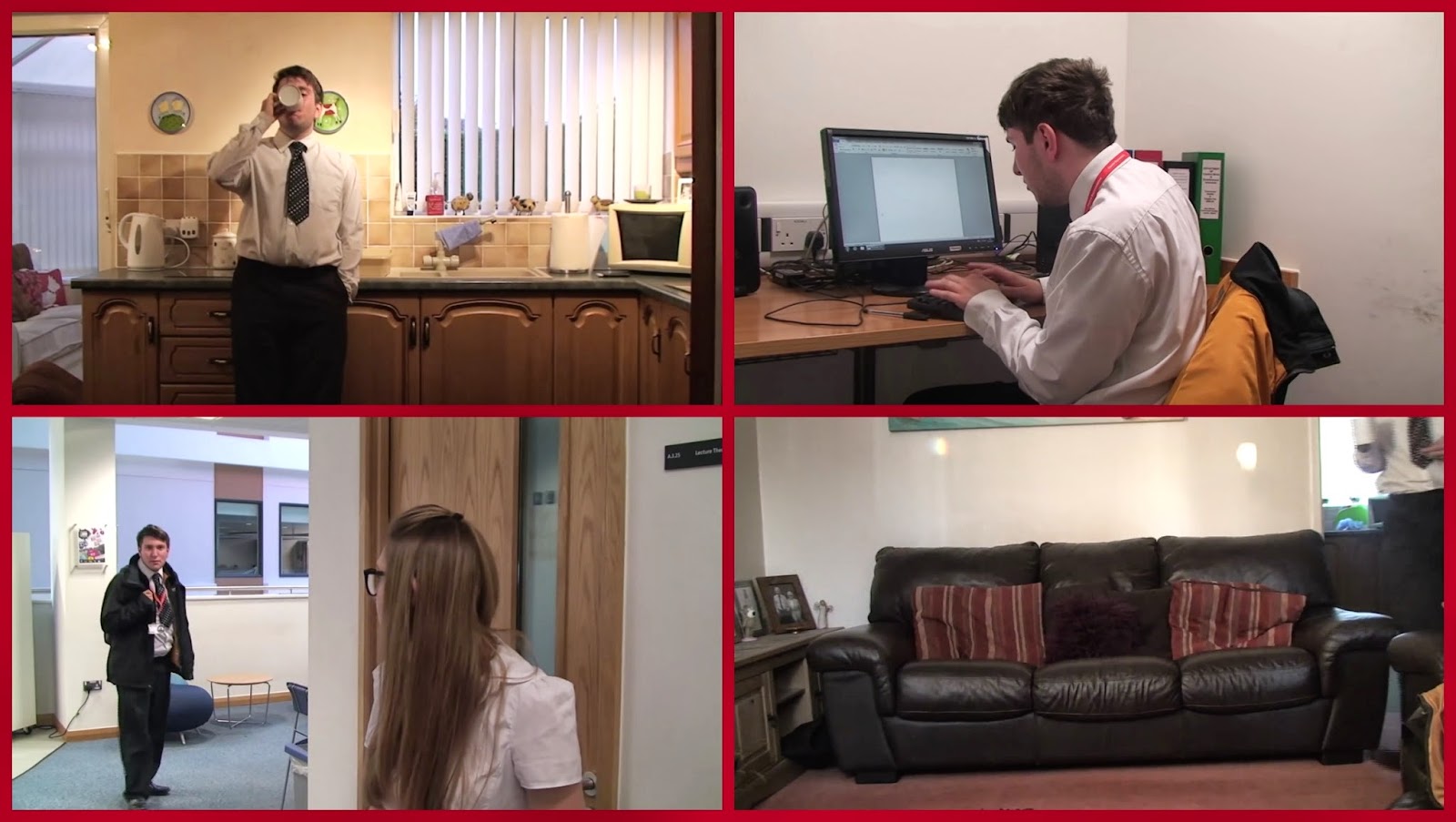
Close ups and cut ins show our protagonist in normal, everyday circumstances, again, persuading the audience the film just follows the repetitive life of David. As David opens his office door, the film cuts to a close of of him fiddling with his keys and struggling to get in, giving the audience a relatable subject to focus on, and, yet again, creating a sense of normality. Close ups were also useful in showing characters reactions and facial expressions, relaying these to those watching and possibly making them feel the same. When hearing a strange glitchy noise, David's face is shown looking confused, breaking away from previous normalcy. This is where the film begins to take a turn, so showing certain expressions through the use of close ups tells the audience something isn't right.

The pace of our film needed to keep the audience interested, as well as making Davids life seem dull. By quickening the pace of the film with short shots, we were able break up any longer scenes and have a smooth transition into establishing the location of David, as did long shots keep the plot neutral and uninteresting. This process lengthened the time it took to edit, but as seen in Office Space, our inspiration, and the results we saw in our final film, showed to be effective. Taking this idea from Office space meant the repetitive nature of Davids was show clearly to the audience, along side the acting and attitude of our protagonist.
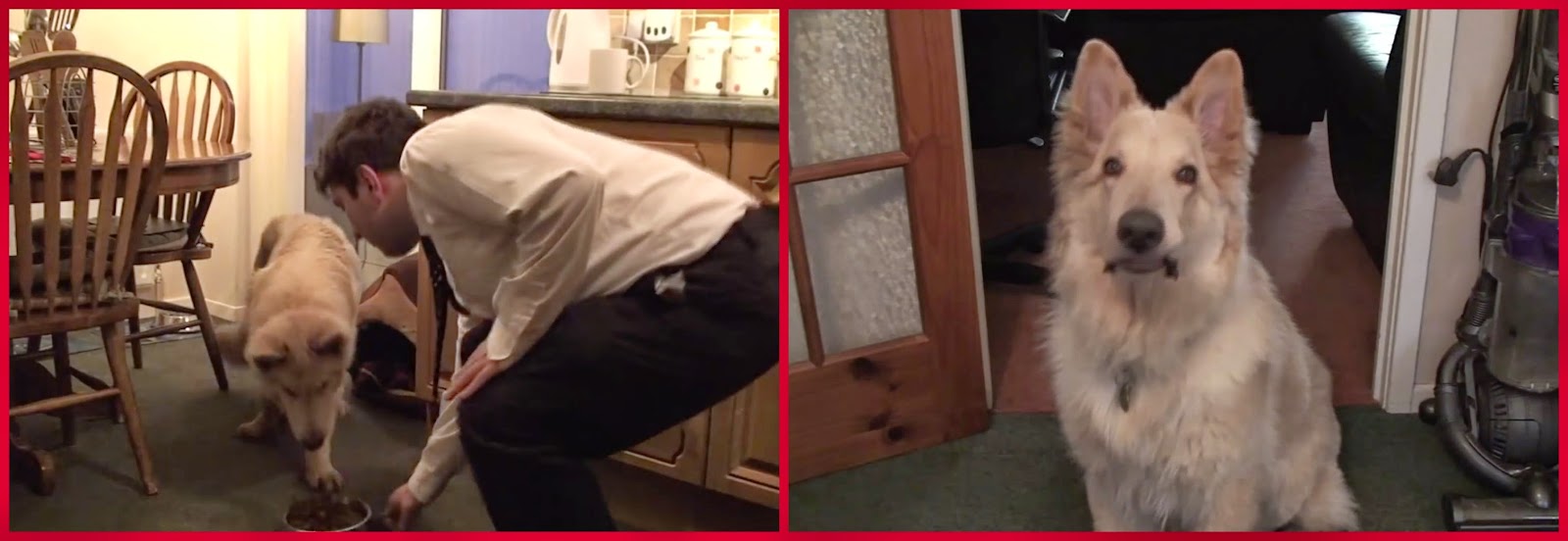
When writing the shot list, we decided to experiment with high and low angled shots. By showing Tim from Davids eye level looking down on him, it not only indicates their height difference, but subtly suggests David’s power over him. As Tim’s owner, David would obviously have control over what he does, but having Tim manipulate David into feeding him when he may not necessarily be due a meal, and taking him out for a walk when Tim wants, foreshadows Davids lack of control. These angles were mainly used, however, to show a realistic height difference between David and Tim. By having Tim look directly into the lens, as the camera is where David is stood, and then having Davis look directly into the lens as if it is Tim made the whole scenario look both comical and authentic, the point-of-view shots hopefully making the audience forget they were watching a film with camera’s and begin to feel engrossed by the two characters.

Working with animals was expected to be rather difficult, and we had chosen to decide on a back up shot list incase Tim didn’t do as instructed. Unfortunately, we he'd become rather set on involving Tim, so chose to only choose after filming what would take the place of Tim’s scenes, however with the aid of cocktail sausages, and Tim’s trained ears meant we were able to gain shots that were suitable. This did mean rather a lot of editing was needed in order to fins the right shot, but we found one none the less.
When it is revealed that David is being controlled by someone playing his life as a video game, we chose a crane show to start the transition from Davids virtual reality into our teenager’s reality. Switching from David to Louise’s made all of the previous glitches make sense, as well as making everything clear to the audience. I feel that the use of high and low angle shots helped to achieve this sense of surprise, by creating a reality that doesn't seem virtual.

Our film was created, originally, as a source of entertainment, but as filming commenced, we realised that it could lead to a deeper meaning. Seeing David live a mundane and pitiful life may make people watch the film and relate their lives to his. This could lead to audience members learning from his mistakes, and choosing to not change his life for the better. Entertainment seemed to be the main audience pleasure we were aiming to provide, as with David losing control over his life could lead to the belief that we aren’t in control of our own lives either. This concept could work in our favour, however, as this could be seen as a modern interpretation of the Christian belief of an all-seeing God, again relating back to the idea of using the film as a moral lesson. The thrill of finding out that the character whose life you have become so attached to during the majority of the film is in fact not real, and that David is unaware of this fact, makes the audience sympathise even more with him.
Struggling to fit the plot into one genre, we defined our film’s story line as a mixture of two, naming it as a Psychological Thriller. Constantly challenging Davids existential thoughts also challenged the audience’s, by making the character relatable. Relating to someone who is unknowingly trapped in a virtual fantasy could lead them to question their existence, emphasising the psychology of its characters and their unstable emotional states. The cliffhanger and the intense score, coupled with David being completely oblivious also made it a thrilling film to watch.
Dyers there of representation suggests that two people from different backgrounds, who are into two different things, have different jobs etc. means they are completely different. Stereotypes are usually exaggerated in films to get the producers point across to the audience clearly, for example, to indicate a male character is gay, they may act more flamboyant that the straight characters along side them, when in reality, being flamboyant and gay are two completely different things. Our film includes no strong stereotypes, but does, however, show differences in how characters interact with each other. For example, the two coworkers introduced in Davids building constantly converse as David walks by, and seem to be rather fond of each other’s company, however the way they talk to David insinuates a slight annoyance. Having David not smile and barely acknowledge the women as he walks by may lead the audience to assume they are constantly talking to each other, and rarely include David in their daily topic. This could be seen as a stereotype, as women are notorious for being spitefully critical, however David isolation could counter act this behaviour, indicating he is intact the reason they don't speak.
Over all, I am pleased with our outcome. We were able to develop on common forms and conventions of the genre we chose to identify our film as through thorough research and were inspired by real media products such as Office Space. Many conventions of a Psychological thriller depend on the storyline of the film, and whether it fits the plot, so avoiding some conventions would have been inevitable, however the themes of mental imprisonment and identity were strong influences on how our film was organised.
Evaluation Question 3
3 What have you learned from your audience feedback?
In order to get the best out of our story line, we highly relied on audience feedback throughout the whole process of creating our end product. During the production, we were sure to show members of our class rough cuts and ask for advice on certain aspects of our film, and the feed back we gained from our video questionnaire was taken on board as soon as we received it. Having this feedback allowed us to work closely with the audience we were aiming our film towards, and get the best outcome possible.
Using BBFC, we quickly set upon finding a suitable classification to fit out storyline and any initial ideas we had discussed during lesson. Having a basic idea of who our film should be aimed towards meant we could set upon making ideas written on paper come to life, and scrap any inappropriate scenes. After looking at the middle age restrictions, 12, 12A and 15, which were the most suggested in our video questionnaire, we felt our story line would fit most comfortably under a 12A. Here is what we would need to keep in mind during the creation of our film, according to the BBFC official website:
- Moderate violence
- No emphasis on injuries or blood, but occasional gory moments may be permitted
- Action sequences and weapons may be present at 12A or 12, and there may be long fight scenes or similar.
- Weapons which might be easily accessible to 12 year olds (such as knives) should not be glamorised.
- Sexual violence, such as scenes of rape or assault, may only be implied and must also have a strong contextual justification.
- Moderate physical and psychological threat is permitted as long as horror sequences are not too frequent or sustained and the overall tone is not disturbing.
- Dangerous behaviour (for example hanging and suicide) may be present lacking details which could be copied or present those activities in a manner that children are likely to copy.
- Anti-social behaviour should not be endorsed.
- There may be infrequent sight of drugs misuse in a 12A or a 12 but the portrayal should not be glamorised or provide instructional detail.
- Sex may be briefly and discreetly portrayed
- Verbal sex references should not go beyond what is suitable for young teenagers.
- Comedy may lessen the impact of some moderate sex references or innuendo but frequent crude sex references are unlikely to be accepted at this category. There may be nudity in 12A films but nudity in a sexual context should only be brief and discreet.
- Sex and sex references are treated the same irrespective of sexuality
- Any discriminatory language or behaviour will not be endorsed by the work as a whole. Aggressive discriminatory language (for example homophobic or racist terms) is unlikely to be passed at 12A or - - 12 unless it is clearly condemned.
- The BBFC's Guidelines state that strong language (e.g. 'f***') may be passed at 12 or 12A, depending on the manner in which it is used, who is using the language, its frequency and any special contextual justification.


Overall our film gained positive feedback. No one found any major faults with our films, and any criticism we gained was given constructively and was easily justified. We were very pleased with how our film was received, and found that our thoughts were conveyed effectively. Many people agreed with out certification being 12A, and although there was a mixture of genre suggestions, we gained many Psychological Thriller/Drama answers, which is the genre we hoped people would identify the film as. Everyone seemed to really enjoy the film, however very few though it would suit a mainstream cinema, only online download and streaming, however we did have one or two local cinema propositions. Our main aim was to entertain our audience, and from the results of our final questionnaire I am confident in saying we achieved that.
Sunday, 12 April 2015
Tuesday, 7 April 2015
Editing Research
Title Text
http://www.macprovideo.com/hub/motion/animating-shape-masks-in-motion
http://www.macprovideo.com/hub/motion/animating-shape-masks-in-motion
During our
Bus Swiping
Tried it
What we did
Decided it didn't look good because of difference in speed between the bus and the lift doors opening - chose to do alternative.
Glitches
Friday, 27 March 2015
Location: Office Building
Office Entrance

Although the shots in this location will be brief, we still wanted them to look authentic and match the locations that will go before it. These areas could be quite noisy but we could be remove the sound and put ambient music over the shots if the noise level is a problem as there will probably be music linking these few shots together anyway to make the scene flow.
David's Office

When deciding what room to use as David's Office, we had a number of options to choose from. In order to achieve the shots we wanted, the office door preferably needed to be located on a long, wide corridor, and have no glass windows looking into the room, unless that room was ideal to be used for his actual Office.
Essential props for this location: Computers, pens, mugs, badges, miscellaneous office supplies eg. staplers, hole punches, photocopiers, printers (it is not essential that we should use these exact props but if we did then they would increase the verisimilitude of our film.)
After filming in this location, we realised a fault in our footage and decided to re-film the whole scene. Coming back to this office became difficult, resulting in a change of scene. In order for it to become easier to film quickly, and still gain a clear and decent shot, we chose a smaller room on the corridor of our editing suite.
Essential props for this location: Computers, pens, mugs, badges, miscellaneous office supplies eg. staplers, hole punches, photocopiers, printers (it is not essential that we should use these exact props but if we did then they would increase the verisimilitude of our film.)
After filming in this location, we realised a fault in our footage and decided to re-film the whole scene. Coming back to this office became difficult, resulting in a change of scene. In order for it to become easier to film quickly, and still gain a clear and decent shot, we chose a smaller room on the corridor of our editing suite.
Corridor

This corridor is exactly what we were looking for our film as it has a generic office feel and also has added bonuses like the water dispenser. It is quite out of the way which means that the noise will hopefully be minimal and we won't be getting in people's way when we film. We will have to cover up any signs that indicate that it is a college building but this can easily be done but printing off some sort of poster, which would be suitable for the office that David works in, as putting it over the top. The corridor is also quite wide so we will have maneuverability in the space, which will make it more safe and efficient. In order to keep our film realistic, we will need to either remove the poster placed behind the water dispenser or make sure it isn't visible in the scenes we shoot there.
Lift

Using the floor with a yellow wall was perfect in giving off a certain mood to the audience. When seeing yellow, our audience are more likely to feel happy and 'normal', just as David himself seems to be. Unfortunately, we were unable to use this floor due to difficulty in filming in the lift itself. The footage we used was taken in another lift, one used less often, and in a short space of time, in order to gain a usable shot, however the limited time meant our footage was very short.
Location: Bus Stop
When deciding on a bus stop to use for this shot, we had to consider what restrictions would cause a problem for us. When following the shot list, we noticed a wide shot was used during this scene, and therefore had to ensure we had enough room away from the bus stop to gain a clear shot. Having this in mind, we chose against using a stop close to our home location, one we originally planned to use, as it was near a busier and inconvenient road, so the final location ended up being an unsheltered stand outside of college, the building used for David's Office. Although this location change made no major difference to our film, we had hoped to use a sheltered stop, giving the audience a place to focus on.
Using a bus stop with a larger road between where the camera would be compared to the stop itself meant we had more leverage when it came to gaining the perfect shot. The road was lucky enough to give us enough room for the shot we wanted, but it still had a large amount of space in which we could maneuver the camera, just had we had hoped.
Essential props for this location: Bus, bag.

Location Change: David's Office
Location Change: The Lift

Using the floor with a yellow wall was perfect in giving off a certain mood to the audience. When seeing yellow, our audience are more likely to feel happy and 'normal', just as David himself seems to be. Unfortunately, we were unable to use this floor due to difficulty in filming in the lift itself. The footage we used was taken in another lift, one used less often, and in a short space of time, in order to gain a usable shot, however the limited time meant our footage was very short.
Saturday, 21 March 2015
Influences On Our Film
The Stanley Parable:
The idea of watching and controlling someones life is a heavy influence in this video game, as it is in our film. Where our film hides the fact the protagonist is trapped in a fictional world, this game plays off of this idea. Stanley, like David, leads an ordinarily repetitive life, and the plot follows how he deals with change, similarly to Davids near discovery of his fictional home.
Jack and Dean's Sketch "The Last Supper"
Jack and Dean are two popular film makers, who focus mainly on comedy sketches. Their cinematography inspired some of our film's shots, such as the crane shot and the use of simple special effects.
Pj Liguori's Short Film "Office Space"
Again, Pj Liguori's film influenced our plot and storyline. His main character is tired of doing the same job everyday, and tries to escape the boredom he encounters. The repetitive nature of this characters life, working in an office building and encountering only a few people gave us the a main outline of where to set our story, as well as solidifying our choice to use a limited number of characters.
The idea of watching and controlling someones life is a heavy influence in this video game, as it is in our film. Where our film hides the fact the protagonist is trapped in a fictional world, this game plays off of this idea. Stanley, like David, leads an ordinarily repetitive life, and the plot follows how he deals with change, similarly to Davids near discovery of his fictional home.
Jack and Dean are two popular film makers, who focus mainly on comedy sketches. Their cinematography inspired some of our film's shots, such as the crane shot and the use of simple special effects.
Pj Liguori's Short Film "Office Space"
Again, Pj Liguori's film influenced our plot and storyline. His main character is tired of doing the same job everyday, and tries to escape the boredom he encounters. The repetitive nature of this characters life, working in an office building and encountering only a few people gave us the a main outline of where to set our story, as well as solidifying our choice to use a limited number of characters.
Friday, 6 March 2015
Monday, 2 February 2015
Friday, 23 January 2015
Subscribe to:
Posts (Atom)